

SmartNova, a vendor-agnostic contact center integrator working across Genesys, Verint, Omilia and NovaTalks, has reviewed the new Genesys report «2026 State of Customer Experience». It gathers responses from 5,811 consumers and 1,560 CX and business leaders across more than 20 countries, with fieldwork carried out in March and April 2026. The sample covers banking, insurance, telecommunications, retail, healthcare, manufacturing, airlines, government and utilities.
The full study is available on the Genesys website.
This year’s edition records an important shift. For the first time since 2023, contact center leaders put maintaining service quality on aging systems at the top of their operational challenges. Rising customer expectations, which had led that list for three years, dropped from first place.
So what do customers expect from service now? Where exactly does it break down? And why is AI investment not producing the return enterprises planned for? Here are the main findings.
Key findings from the Genesys 2026 report
- Maintaining service quality on aging systems is now the top operational challenge for contact centers, displacing rising customer expectations for the first time since 2023.
- Only 31% of CX infrastructure is fully cloud-based, a figure unchanged from the 2025 edition.
- 91% of consumers judge a company by the standard of its service, nine percentage points higher than in the previous edition.
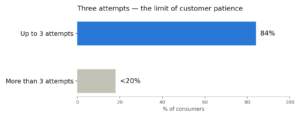
- Customers allow a virtual agent three attempts: 84% will give that many, and fewer than 20% will give more.
- 40% of organizations already use agentic AI, and 82% of leaders expect autonomous agents to run the customer journey end to end within three years.
- European organizations put 29% of their service budget into AI against a global 30%, yet trail on every headline delivery measure.
What customers expect from service in 2026
Customer service has stopped being a support function. According to the Genesys 2026 report, 91% of consumers judge a company by the standard of its service. In the previous edition that figure stood nine percentage points lower, the sharpest move of any metric in the study.
The frame of reference has changed as well. 92% expect every organization to deliver an experience on par with the best they have ever had anywhere. Comparison within a category no longer applies: a bank is measured against a delivery service, an insurer against a marketplace.
What customers mean by good service:
- fast and complete resolution, with 76% saying they do not care whether a person or an AI delivers it;
- empathy, which 94% value as highly as efficiency;
- the ability to move between channels without explaining themselves twice, which matters to 95%;
- access to a human agent at the point where one is needed.
The cost of missing those expectations is measurable:
- 85% of consumers reduced spending or stopped buying altogether after poor service, with 42% leaving permanently and 43% spending less;
- 57% would definitely or probably switch to a competitor after an interaction that lacked empathy;
- 47% would switch after two or three bad interactions with a brand they consider a favorite;
- 21% would switch after a single one.
Loyalty built over years does not absorb three consecutive failures.
Why expectations rose: customers got used to AI
The bar was raised by everyday consumer technology. AI has become a daily tool: 52% of consumers use it at least weekly in their personal lives and 53% do so at work. Fast answers, natural conversation and low effort no longer impress. They are the baseline a customer brings into every service interaction.
Expectations of service moved accordingly:
- 76% believe AI will improve the quality and speed of customer service within two to three years;
- 75% expect it to improve personalization;
- 46% are comfortable with AI making decisions on their behalf when doing so speeds up resolution.
Trust in automation, however, is built by direct experience. 50% of consumers feel more positive about AI-powered service than they did two years ago, and 30% of them attribute that shift to a good experience they had themselves. Among the 19% who feel more negative, 48% trace it to one specific bad interaction in the past year.
The implication for enterprises is straightforward: every deployment either builds trust in the technology or spends the trust already built.
Three attempts to a virtual agent: where customer patience ends
The Genesys 2026 report treats omnichannel service, meaning the ability to move between channels without explaining yourself twice, as a baseline consumer assumption rather than a competitive advantage. It also shows precisely where patience runs out.
84% of consumers will give a virtual agent up to three attempts to resolve their issue. Fewer than 20% will allow more than three. For anyone designing those flows, this is a concrete benchmark: having a virtual agent matters less than what happens on the third attempt. If the flow has no clean exit to a human agent at exactly that point, the organization loses the customer.
The second problem is context persistence across an omnichannel contact center. 95% of consumers consider it important that information they have already provided moves with them across channels. Reality differs:
- 26% have had to repeat to a human agent what they already told a chatbot;
- 33% have repeated the same information to different human agents;
- 20% say that after such a repetition they want to stop using the brand entirely.
We have covered the architecture behind this separately, in our own piece on why omnichannel is not multichannel and what true data persistence actually requires. Being unable to reach a human agent at all tops the list of things that make consumers vow never to use a company again. Automation becomes a problem at the moment it turns into a wall between the customer and the person who can actually solve the issue.
The contact center manager at Banco de Crédito, whose comments the report cites, observes that nothing frustrates customers more than having to explain their issue a second time. In her account, a customer who has already spoken to a virtual agent does not want to repeat that conversation to the human agent who picks it up next.
Consumer expectation against reported reality, Genesys 2026 data
| What consumers expect | What the data shows |
|---|---|
| 95% – information should travel across channels | 26% repeated it to an agent after using a chatbot |
| 83% – waits beyond 15 minutes are unacceptable | 44% waited more than 15 minutes in the past year |
| 94% – the right to know they are talking to AI | 26% of leaders rank responsible AI a top priority |
| 92% – service on par with the best they have had | 31% of CX infrastructure is fully in the cloud |
Self-service itself performs better than its reputation suggests. 65% of consumers say virtual agents have made it easier to solve issues on their own, and 78% think companies are getting better at providing effective self-service. Inside the flow, automation works. It falls apart at the seams between flows, channels and people.
Why AI is not delivering: the problem is CX infrastructure
This is where the Genesys 2026 report makes its most important finding. For the first time since 2023, leaders put maintaining service quality on aging infrastructure at the top of their operational challenges. Until 2026, organizations were falling behind their customers. Now they are falling behind their own systems.
The state of that infrastructure explains why. On average, only 31% of CX infrastructure is fully cloud-based, which leaves 69% running outside it. Compared with the 2025 edition, that number has not moved. Across a year dominated by AI deployment, the foundation stayed where it was. We have turned that assessment into a practical checklist in our own article on the contact center audit, with ten signs that infrastructure has aged past the point of usefulness.
The ranking of technology challenges points the same way:
- managing and maintaining data so it remains usable for AI, 46%;
- keeping up with the pace of AI innovation, 46%;
- readiness and technical ability to adopt AI at scale, 44%;
- demonstrating ROI, 42%;
- lack of the right technical skills in the team, 40%.
All five concern the foundation those tools run on. The report separately lists lack of consolidated data among the internal issues that stop organizations delivering a seamless customer journey, which is the practical face of data silos across legacy systems.
Where leaders intend to go is clear from their plans. 73% say a platform that integrates and interoperates with other enterprise systems is critical to their strategic CX goals. 90% expect their CX platform to be connected to middle- and back-office systems within three years, meaning the systems where the request is actually fulfilled: billing, claims, logistics. A further 67% call that link critical to reaching their goals, and 91% expect to run the customer journey end to end within the same horizon.
Agentic AI sharpens the question further. These are systems that plan several steps ahead and carry them out, rather than answering along a script. 40% of organizations already use them in some form, 41% deploy agentic virtual agents in customer interactions, and 82% expect these agents to run the customer journey end to end within three years.
This is where the real constraint appears. An autonomous agent can only act across the systems it can actually reach. Deployed over data silos and disconnected platforms, agentic AI speeds up individual interactions while the journey stays broken, and the journey is what the customer judges.
In comments cited in the report, the same contact center manager frames the wider point plainly: delivering an end-to-end journey requires the entire business to prioritize orchestration, not the service function on its own.
Two figures in the report are worth reading together, although they appear in separate sections: 40% of organizations already use agentic AI, while only 31% of CX infrastructure is fully cloud-based. A share of those deployments therefore runs on infrastructure that has not yet been consolidated. For assessing readiness, that overlap is a more useful signal than the headline adoption rate.
Dmitry Kondrashov, Business Development Manager, SmartNova
What happens to contact center agents
The Genesys 2026 report does not support a replacement narrative. 91% of leaders believe human agents will remain a critical part of delivering CX three years from now. 90% expect human agent interactions to be complex or emotionally charged.
What changes is the content of the work. Routine contacts move to automation, while judgment, accountability and empathy stay with people. Leaders do not understate the scale of that change: 88% expect contact center roles to look markedly different within three years, and 87% expect an integrated human-AI workforce to be a reality in that time.
The report records the other side of that shift. AI-powered scheduling and quality management tools, in other words workforce management functions, have cut the manual effort of staffing while sharply increasing the share of interactions covered by quality review.
That creates a new workforce requirement. Building AI literacy across teams ranks as the second-greatest operational challenge in the entire study. At the same time, organizations using AI agent assist are 18% more likely to believe they are reducing customer effort than those that are not.
Customers want to know they are talking to a bot
According to the Genesys 2026 report, consumer expectations have moved beyond speed and convenience:
- 94% believe they have a right to know when they are interacting with AI;
- 69% believe companies should disclose when AI is being used;
- 66% want full control over the personal data they share.
Enterprise priorities have not kept pace. Only 26% of CX leaders rank responsible AI among their top priorities for the next three years, ten percentage points below the survey mean. The gap between what customers ask for and what organizations plan for is among the widest in the report. In European markets, where GDPR applies and AI regulation is taking shape, that gap carries legal weight in addition to reputational risk.
The AI adoption gap: Europe vs. Latin America and beyond
The Genesys 2026 report shows agentic AI adoption split sharply by region:
| Region | Currently using agentic AI-powered / autonomous virtual agents |
| Europe | 31% |
| Global average | 41% |
| Asia-Pacific | 44% |
| Latin America | 50% |
| Middle East & Africa | 55% |
But the sharper picture shows up once the data is broken down by country rather than region. Three delivery metrics tell a more dramatic story, especially between Europe and Latin America:
Automatically surfacing previously collected customer information to agents:
| Country | % | Country | % |
| France | 34% | Brazil | 63% |
| Germany | 46% | Mexico | 58% |
| Ireland | 43% | Other LATAM | 61% |
| United Kingdom | 48% |
Delivering extremely personalized customer service:
| Country | % | Country | % |
| France | 21% | Brazil | 57% |
| Germany | 18% | Mexico | 33% |
| Ireland | 27% | Other LATAM | 32% |
| United Kingdom | 28% |
Significantly minimizing customer effort:
| Country | % | Country | % |
| France | 6% | Brazil | 43% |
| Germany | 5% | Mexico | 16% |
| Ireland | 11% | Other LATAM | 13% |
| United Kingdom | 21% |
The widest gap is in customer effort reduction, where Germany (5%) and France (6%) sit far below Brazil (43%) – an eight-fold difference on the same metric. This is a sharper contrast than the regional agentic AI adoption figures alone suggest.
What makes this gap notable is that it is not a story about money. European organizations spend almost exactly what the rest of the world spends on AI-powered CX technologies, yet the delivery outcomes trail well behind. The next section looks at that budget-versus-outcome mismatch in more detail.
Europe spends the same and gets less
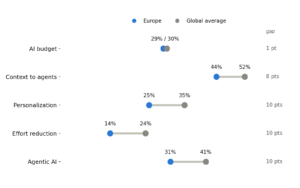
European figures in the Genesys 2026 report diverge noticeably from the global picture. 66% of European consumers believe AI will improve service quality and speed, against 76% globally. 38% feel more positive about AI-powered service than two years ago, against 50% globally. Daily AI use at work stands at 18% in Europe against 25% worldwide.
The delivery gap is wider still:
- 44% of European organizations automatically surface previously collected customer information to agents, against 52% globally;
- 25% report delivering extremely personalized service, against 35%;
- 14% report significantly minimizing customer effort, against 24%;
- 31% use agentic AI-powered virtual agents, against 41% globally.
The most revealing comparison concerns money. European organizations put 29% of their customer service budget into AI-powered CX technologies; the global figure is 30%. The spend is level and the return is lower. What differs is how well connected the systems are that the money goes into. European leaders are also more likely than their global peers to prioritize reducing cost to serve, at 35% against 29%.
European data has a real strength too. 29% of CX leaders in the region build their processes around loyalty and empathy, the highest of any region against a global average of 18%, and highest of all in France at 43%. The European market is more cautious about automation and clearer than most about what it wants automation to achieve.
One caveat on scope. The European sample covers the United Kingdom, France, Germany, Ireland and other EU countries. Readers in Poland, Slovakia and Romania should treat these figures as European trends rather than as market-specific data, since individual country breakdowns for those markets are not published in the report. The underlying pattern holds regardless: money spent on AI returns little where the systems behind it are disconnected.
The European figures show a gap that money does not explain. AI budget share in Europe stands at 29% against 30% globally, so investment is effectively level. Yet automatic context delivery to agents runs at 44% against 52%, personalization at 25% against 35%, and effort reduction at 14% against 24%. The result depends on how well connected the systems are that the money goes into.
Dmitry Kondrashov, Business Development Manager, SmartNova
Conclusions: what enterprises should do
Enterprise CX in 2026 comes down to how well an organization’s systems are connected to one another. Genesys closes the report with five recommendations: modernize CX on a unified platform, design for the full journey rather than individual interactions, build the hybrid workforce with intention, make responsible AI a design principle, and embrace agentic orchestration. Below are four steps that follow from the data and match what we see in contact center integration projects.
- Consolidate data and systems first, then scale automation. Otherwise the number of tools grows while the journey stays just as broken.
- Design the full journey from first contact to resolution. The biggest losses happen at the handovers: virtual agent to human agent, channel to channel, and front office to the back-office teams that actually complete the request.
- Build transparency and data control into the architecture from the start rather than adding them after go-live.
- Judge the result by what the customer experienced. A list of available features guarantees nothing: the gap between 90% self-assessment and the 44% who actually waited over 15 minutes opens up exactly where organizations count capabilities instead of outcomes.
Where to start
SmartNova architects contact center ecosystems for enterprise organizations across banking, insurance, telecommunications and retail. We work as a vendor-agnostic contact center integrator across Genesys, Verint, Omilia and NovaTalks, so our first question is always about the architecture a client already runs.
This report describes the kind of problem that rarely goes away by replacing a single tool. Where customer expectations outpace what existing systems can deliver, start by assessing what is already in place: where context is lost between data silos, which integrations are missing, and which data is genuinely usable for automation today.
If you are evaluating agentic AI or planning a platform migration and are unsure how your legacy dependencies will behave, let us benchmark your architecture. Schedule a 30-minute technical session with a SmartNova solutions architect to map the integration constraints before the technology decision is made.
The «2026 State of Customer Experience» report can be downloaded from Genesys and read in full, including the regional sections on Asia-Pacific, Latin America and the Middle East and Africa, which this review does not cover.
Frequently asked questions
What is the Genesys 2026 State of Customer Experience report?
It is the fifth annual customer experience study published by Genesys. It surveyed 5,811 consumers and 1,560 CX and business leaders across more than 20 countries, with fieldwork carried out in March and April 2026.
What is the biggest contact center challenge in 2026?
Maintaining service quality while operating aging infrastructure. Leaders put it at the top of their operational challenges for the first time since 2023, and rising customer expectations dropped from first place.
How widespread is the cloud contact center?
On average 31% of CX infrastructure is fully cloud-based, which leaves 69% not yet migrated. The figure is unchanged from the 2025 edition of the study.
How many attempts do customers give a virtual agent?
Three. That is what 84% of consumers will allow, while fewer than 20% will give a virtual agent more than three attempts.
What frustrates customers most in service interactions?
Being unable to reach a human agent tops the list of reasons customers vow never to use a company again. Repetition follows: 26% of consumers have had to repeat to a human agent what they already told a chatbot, and 33% have repeated the same information to different human agents.
How widely is agentic AI adopted in customer experience?
40% of organizations already use agentic AI and 41% deploy agentic virtual agents in customer interactions. Within three years, 82% of leaders expect these agents to run the customer journey end to end.
How do European figures differ from the global average?
European organizations invest at almost exactly the global rate, 29% of budget against 30%, but report lower delivery: automatic context handover to agents at 44% against 52%, personalization at 25% against 35%, and customer effort reduction at 14% against 24%.