

For decades, contact centers have operated on a fundamental assumption: you can understand your customers by listening to a small slice of their conversations. QA teams sample 3–5% of calls. Supervisors spot-check flagged interactions. Leadership reads monthly reports built on that partial data and makes decisions accordingly.
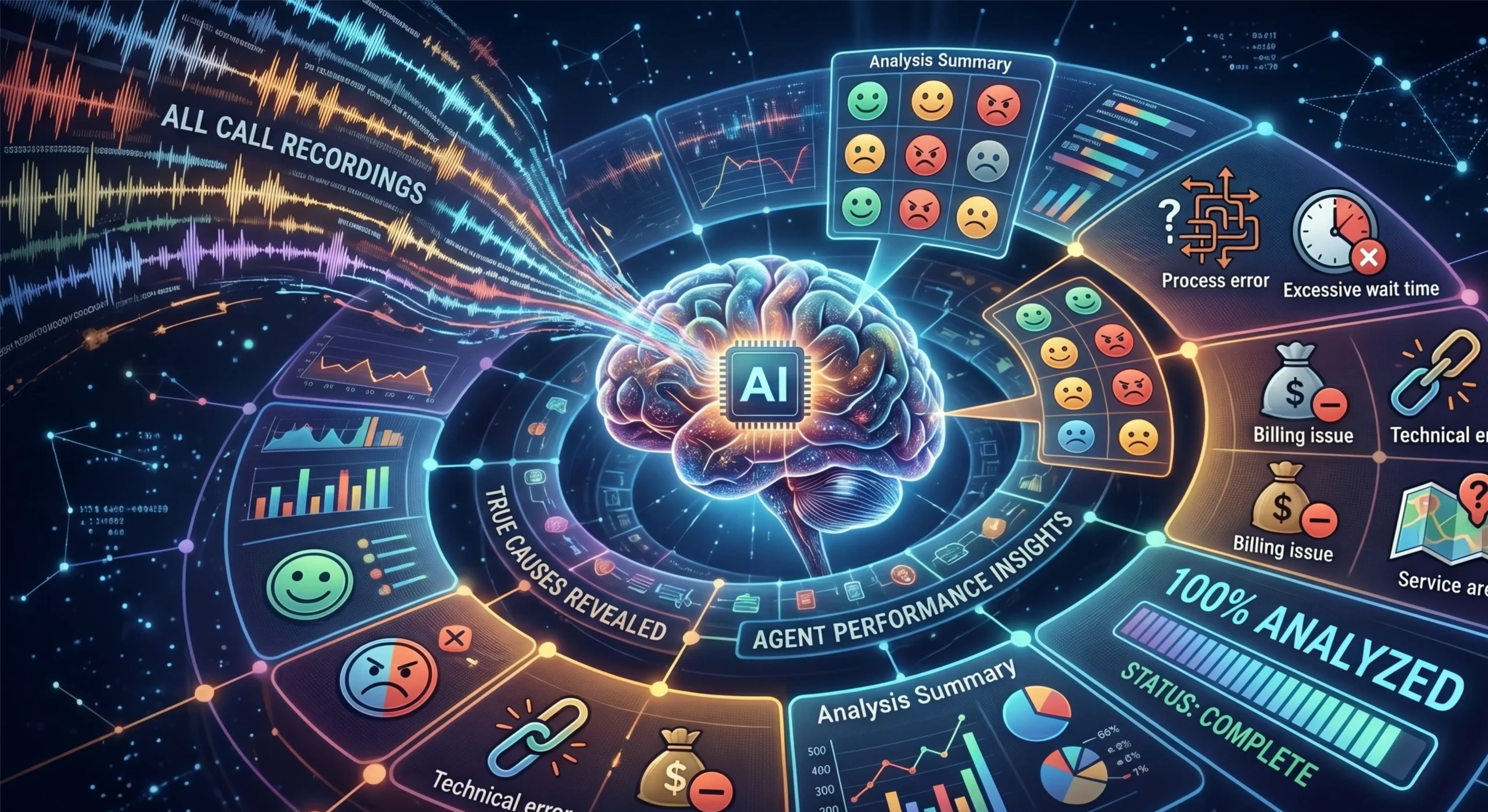
Speech analytics breaks that assumption entirely. When you analyze 100% of recorded interactions automatically — every call, every chat, every voice message — a different picture emerges. Not the picture you expected. The picture that’s actually there.
The Sampling Illusion
Random sampling feels rigorous. It has the language of statistics behind it. But in practice, sampling a contact center produces a deeply incomplete view of what customers are experiencing — and more importantly, why they’re dissatisfied.
Consider what gets missed in a 5% sample. A compliance breach that affects 8% of calls. A specific agent behavior pattern that only surfaces in late-shift interactions. A product defect that customers mention obliquely, in ways that don’t trigger a formal complaint but cluster unmistakably in the data. A script phrase that reliably precedes call escalations. None of these patterns are visible in a sample. They require the full dataset.
The second problem with sampling is selection bias. Manual QA reviewers, consciously or not, gravitate toward calls that are interesting — escalations, complaints, unusual scenarios. The mundane majority goes unheard. But customer dissatisfaction often lives in the mundane: the slightly confusing explanation, the unnecessary hold, the moment a customer’s tone shifts and no one notices.
Sampling tells you what you already suspected. Full-coverage analytics tells you what you didn’t know to look for.
What Speech Analytics Actually Does
Modern speech analytics platforms do several things simultaneously across every recorded interaction:
Transcription converts audio to searchable text in real time or post-call. Quality has improved dramatically — current systems handle accents, technical terminology, and overlapping speech with accuracy rates that make the transcripts genuinely useful for analysis rather than just archival.
Sentiment analysis tracks emotional tone throughout a conversation — not just at the end, but moment by moment. It can identify the exact point in a call where a neutral customer became frustrated, which is often far more actionable than knowing they were frustrated overall.
Topic detection automatically categorizes what each conversation is about, without requiring agents to tag them manually. It surfaces emerging themes before anyone thinks to look for them — a new product defect, a confusing policy change, an invoicing error affecting a segment of customers.
Silence and overtalk detection flags calls with abnormal silence (indicating confusion, system delays, or agent uncertainty) and calls where the agent and customer speak simultaneously (often a sign of miscommunication or a frustrated customer being talked over).
Script adherence monitoring checks whether agents are delivering required disclosures, following approved language, and avoiding prohibited phrases — across every single interaction, not just the ones someone happened to review.
Finding the True Causes of Dissatisfaction
The gap between stated and actual causes of customer dissatisfaction is one of the most consistent findings in contact center analytics. What customers complain about formally — long wait times, unfriendly agents, unresolved issues — often masks a different root cause that only becomes visible when you examine the full interaction record.
The complaint behind the complaint
A telecom company running speech analytics on their retention queue discovered that the majority of customers calling to cancel weren’t primarily frustrated by price — they were frustrated by a billing explanation they had never understood. The dissatisfaction had been attributed to price sensitivity in manual reviews because that’s what customers said when asked directly. The analytics showed something different: a specific moment in the billing explanation where sentiment consistently dropped, two or three calls before the cancellation call. The root cause wasn’t price. It was a confusing line item that made customers feel they were being deceived.
This kind of finding — the complaint behind the complaint — is almost impossible to surface through sampling or surveys. It requires the ability to look across thousands of interactions and find the pattern.
The silence that precedes churn
Unresolved issues rarely announce themselves. Customers who are about to churn don’t always escalate or complain — they go quiet. Speech analytics can identify the behavioral signatures that precede churn: shorter calls, less engagement, specific phrases that correlate with imminent cancellation. These signals appear in the full dataset months before the customer actually leaves, creating a window for proactive intervention that reactive QA processes simply cannot provide.
Agent behavior patterns at scale
Individual coaching based on sampled calls is necessarily incomplete. A supervisor listening to ten calls a week from a team of fifteen agents is getting a highly filtered view of what that team actually does. Speech analytics removes the filter.
It can show, for example, that agents who use specific empathy phrases at the beginning of a complaint call have measurably higher resolution rates and CSAT scores. Or that a particular closing technique correlates with a spike in re-contacts within 48 hours — meaning the resolution wasn’t as solid as it appeared. These patterns, visible across hundreds of calls per agent, make coaching specific, evidence-based, and fair.
From Insight to Action: The Operational Loop
Analytics without action is just expensive reporting. The contact centers getting the most value from speech analytics have built a tight loop between what the data surfaces and what changes as a result.
- Continuous monitoring — dashboards track sentiment trends, topic spikes, and compliance flags in near real time. A sudden increase in mentions of a specific product issue triggers an alert before it becomes a volume problem.
- Root cause categorization — every flagged interaction is tagged by category, allowing teams to distinguish between process failures, product failures, training gaps, and policy issues. Each category routes to a different owner.
- Structured coaching — agents receive feedback tied to specific call moments, not general impressions. “At 3:42 in this call, your tone shifted and the customer’s sentiment dropped — here’s what the data shows happens next” is a different conversation than “you need to work on your empathy.”
- Cross-functional reporting — insights that belong to product, marketing, or operations are surfaced automatically to those teams, not held inside the contact center. A spike in confusion around a new feature is a product team problem. A recurring complaint about a recent policy change is a communications problem. Speech analytics makes those connections visible.
- Measurement of change — when a process or script is updated in response to an insight, the analytics immediately track whether the intervention worked. The feedback loop closes quickly.
Implementation: What to Expect
Speech analytics implementations vary significantly in complexity depending on your existing infrastructure. A few things to plan for honestly:
Data quality matters more than the platform. If your call recordings are inconsistent — variable audio quality, missing metadata, incomplete capture — the analytics will reflect that. A pre-implementation audit of your recording environment is time well spent.
Taxonomy takes time. The categories and topics you want the system to track need to be defined, tested, and refined. Out-of-the-box topic detection is a starting point, not a finished product. Expect two to three months of calibration before the data is fully reliable.
Agent communication is essential. Introducing 100% call analysis without transparent communication to your team about how the data will and won’t be used is a fast path to trust problems. The most successful implementations involve agents in the design of coaching frameworks and give them access to their own analytics.
Start with a specific question. The temptation to analyze everything at once leads to analysis paralysis. Start with one high-value question — why is our re-contact rate elevated for billing queries? what’s driving CSAT decline in the retention queue? — and build from there.
The Competitive Reality
In 2026, speech analytics is no longer an advanced capability reserved for enterprise contact centers with large technology budgets. Cloud-based platforms have made full-coverage conversation analysis accessible at almost every scale. The question is no longer whether you can afford to implement it. It’s whether you can afford to keep making decisions about customer experience based on 5% of the picture.
Your competitors who have already deployed analytics are seeing things in their customer interactions that you cannot see in yours. They’re identifying dissatisfaction earlier, coaching more precisely, and closing the gap between what customers experience and what leadership believes they experience.
The contact centers still running on sampled QA aren’t just behind on technology. They’re behind on truth.
Customer dissatisfaction has causes. Specific, findable, fixable causes. But those causes are often not what customers say when you ask them, not what surfaces in a 5% sample, and not what shows up in ticket categories selected by agents under time pressure.
They’re in the full record of every conversation — in the moment a tone shifts, in the phrase that consistently precedes an escalation, in the silence that follows a billing explanation no one has ever questioned. Speech analytics makes that record searchable, scalable, and actionable.
You already have the data. The question is whether you’re listening to all of it.